The Immigration Firm Operations Audit: 10 Questions to Ask About Your Own Practice

Most immigration attorneys are excellent lawyers. The firms that struggle to grow are rarely struggling because of legal quality. They are struggling because of operations.
The gap between a firm that feels constantly reactive and one that scales smoothly is almost always an operational gap. Missed deadlines, billing leakage, paralegal bottlenecks, client communication that falls through the cracks: none of these are legal problems. They are systems problems. And systems problems are fixable, but only once you can see them clearly.
This audit is designed to give you that clarity. Ten questions, each targeting a specific operational area where immigration firms commonly lose time, money, or clients. Answer them honestly, and you will have a precise picture of where your firm is strong and where it is vulnerable.
Question 1: Can You See the Status of Every Active Case in Under 60 Seconds?
Not after asking your paralegal. Not after opening three different systems. In under 60 seconds, from wherever you are, with no one's help.
If the answer is no, your case visibility is insufficient for the volume you are managing. You are running your practice on trust and memory rather than on real-time information. That works until it doesn't: until a deadline slips because no one had a clear view of what was coming, or until a client calls to ask for a status update and you have to go find out.
Strong operations means every active case has a single, current record that any authorized team member can open and immediately understand. Documents, tasks, deadlines, recent communication, and next actions all in one place, updated in real time as work happens.
What to look for: A centralized case management platform where status is always current, not a combination of spreadsheets, shared drives, and paralegal memory.
Question 2: How Do You Find Out When a Deadline Is at Risk?
There are two versions of deadline management. In the first, you find out a deadline is at risk when someone notices it and tells you, or when the deadline has already passed. In the second, the system surfaces at-risk deadlines automatically, with enough lead time to act.
Most immigration firms are running version one. They have deadlines stored somewhere, but the tracking is passive: dates in a calendar, entries in a spreadsheet, reminders that an individual paralegal maintains. When that system works, it works invisibly. When it fails, the failure is often irreversible.
In immigration law, passive deadline management is a liability. An H-1B cap window missed by a day cannot be recovered. An RFE response not filed in time results in denial. The stakes are too high for a system that depends on someone remembering to check.
What to look for: Active deadline tracking that surfaces upcoming filings across your entire caseload automatically, escalates as windows close, and assigns clear ownership to every open action.
Question 3: What Happens to Your Cases When Your Best Paralegal Is Out?
Be specific. If your lead paralegal were out for two weeks starting tomorrow, which cases would stall? Which clients would stop receiving updates? Which deadlines would become uncertain?
If the honest answer involves real risk, you have a single point of failure in your operations. The knowledge required to move your cases forward lives in one person's head rather than in a shared system. That person's absence, whether through illness, leave, or resignation, transfers directly into case disruption and client impact.
This is one of the most common and most underestimated operational vulnerabilities in immigration practice. The paralegal who knows everything about your cases is not an asset. She is a liability disguised as an asset.
What to look for: Case records that are complete and current in a shared system, with task ownership and deadlines visible to the whole team, so any authorized person can pick up any case without a briefing.
Question 4: How Long Does It Take a New Case to Go from Intake to Active Preparation?
Time this honestly the next time a new case comes in. From the moment a client agrees to retain your firm to the moment a paralegal is actively working the case, how many days pass? What causes the delay?
For most firms, the answer is longer than it should be, and the delay happens in the same places: slow document collection, manual data entry, email back-and-forth to gather information that should have been captured at intake, and handoffs that get stuck because no one is sure who owns the next step.
Efficient intake is also one of the highest-leverage improvements a firm can make, because the gains compound across every case. Shaving three days off intake for a firm handling 200 cases a year recovers 600 days of throughput annually, without adding any staff.
What to look for: Structured intake workflows where clients complete questionnaires directly into the system, documents are uploaded to the right categories, and reminders go out automatically for missing items.
Question 5: Where Does Attorney Time Actually Go Each Week?
Track it for one week without adjusting your behavior. Not billable hours as recorded, but where your time actually goes. How many hours went to work that required your legal expertise and judgment? How many went to client communication, internal coordination, document chasing, status meetings, and administrative oversight?
For many immigration attorneys, especially at smaller firms, the honest answer is uncomfortable. A significant portion of their week goes to work that does not require their training, their license, or their judgment. That work has to happen, but having it happen on attorney time is one of the most expensive operational choices a firm can make.
This is not a time management problem. It is a systems and role-boundary problem. The right platform and the right operational structure return those hours to the attorney without dropping the work.
What to look for: Clear role boundaries between attorney and paralegal work, automated handling of routine coordination tasks, and a client communication layer that runs on the system rather than on attorney time.
Question 6: How Confident Are You in Your Billing Accuracy?
Not in your billing process, but in the outcome. Are you confident that every billable hour worked on every case last month was captured and invoiced? Are you confident that no matter was invoiced for less than the work it actually required?
Billing leakage at immigration firms is more common than most partners acknowledge. It happens when time entries are made retrospectively from memory rather than in real time. It happens when billing rules are inconsistent or when work is captured in one system and billed from another. It happens when a paralegal completes a billable task and no one connects that completion to a billing entry.
The aggregate impact of billing leakage at a firm handling moderate case volume is significant. Recovering even 10 percent of unbilled time can meaningfully change a firm's revenue picture without adding a single case.
What to look for: Time tracking integrated into case activity, billing that flows naturally from case milestones, and invoicing that does not require manual reconstruction of work done.
Question 7: How Do Your Clients Find Out What Is Happening With Their Case?
Do they find out because your system tells them automatically when milestones are reached? Or do they find out because they emailed to ask, and someone on your team responded?
Client communication is one of the most consistent drivers of both satisfaction and dissatisfaction in immigration practice. Clients who feel informed are forgiving of delays and complications.
Clients who feel left in the dark become anxious, then demanding, then liabilities to the relationship.
The challenge is that proactive client communication at scale requires either a lot of staff time or a system that handles it automatically. Most firms are using staff time, which means communication quality is inconsistent and dependent on individual follow-through rather than on a reliable process.
What to look for: A client portal where case status is visible in real time, and automated updates that go out when meaningful milestones are reached, without anyone needing to manually send them.
Question 8: How Long Does Onboarding a New Paralegal Take Before They Are Fully Productive?
Think about the last time you brought someone new onto the operations team. How many weeks before they were handling cases independently without supervision? How much attorney and senior paralegal time was consumed by training, supervision, and rework?
For most immigration firms, the honest answer is six to twelve weeks before genuine productivity, with meaningful supervision overhead throughout. That onboarding period is expensive in time, in supervisor capacity, and in the quality risk of having work done by someone who is still learning.
The length of the onboarding period is largely a function of where your operational knowledge lives. If it lives in documented processes and a structured platform, a new hire can get up to speed faster because the system itself teaches them. If it lives in tribal knowledge held by experienced staff, every new hire requires those staff to invest substantial time before the new person becomes productive.
What to look for: Documented workflows, structured case templates, and a platform that guides users through defined processes rather than leaving new hires to figure out the system through observation.
Question 9: What Is Your Filing Error Rate, and How Do You Know?
This one is uncomfortable because most firms do not have a clean answer. They know about the errors that resulted in RFEs or rejections. They may not know about the errors that were caught internally before filing, or the near-misses that a more thorough review would have surfaced.
Filing errors in immigration law carry real consequences: USCIS rejections, RFEs that require expensive attorney time to respond to, and in serious cases, case denials that damage client relationships and firm reputation. The causes are almost always systematic rather than individual: inconsistent review processes, manual form preparation without validation, document checklists that exist in someone's head rather than in the system.
A firm that cannot answer this question does not have visibility into one of its most important quality metrics.
What to look for: Standardized review checklists for each case type, form preparation that auto-populates from case data with validation, and a clear record of review steps completed before any filing.
Question 10: If Your Case Volume Doubled Tomorrow, What Would Break First?
This is the stress test question. Not what would be harder, but what would actually break. Which part of your operation has the least headroom?
The answer tells you where your real constraint is. For most immigration firms, the honest answer is one of three things: paralegal capacity would be exhausted almost immediately, deadline tracking would become unreliable as volume increased, or client communication would degrade because no one would have time to keep clients informed.
Knowing your constraint in advance means you can address it structurally before growth forces the issue. The firms that scale smoothly are not the ones that respond to capacity problems after they appear. They are the ones that build operations capable of absorbing growth before the growth arrives.
What to look for: An operational structure where case volume can increase without proportionally increasing coordination overhead, attorney time on non-legal work, or risk of errors and missed deadlines.
Scoring Your Audit
If you answered confidently and positively to eight or more of these questions, your firm has strong operational foundations. The gaps that remain are refinement opportunities, not structural risks.
If you answered confidently to five to seven, you have a functional operation with identifiable vulnerabilities. The questions where you hesitated or qualified your answer are the ones worth addressing first, in roughly that order.
If you answered confidently to fewer than five, your firm's operations are not keeping pace with its legal quality. The risk is not that something will eventually go wrong. It is that things are already going wrong, in ways you cannot easily see, and the cost is being absorbed by your team, your margins, and your clients.
What the Benchmark Looks Like
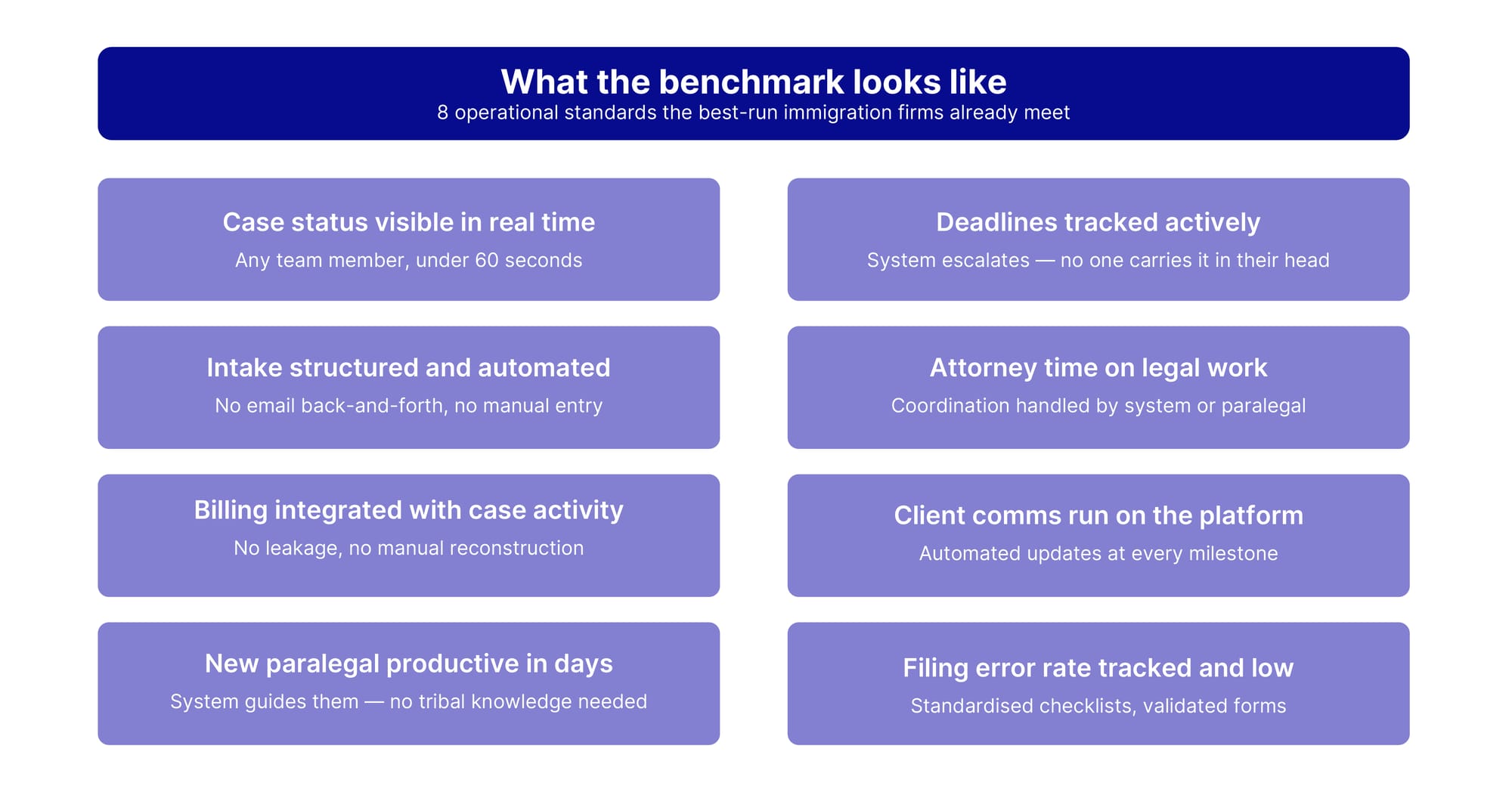
The immigration firms operating at the highest level of efficiency share a common profile. Case status is visible in real time across the entire caseload. Deadlines are tracked actively by the system, with escalation built in. Intake is structured, not improvised. Attorney time is preserved for legal work. Billing captures the work that was actually done. Client communication runs on the platform, not on individual staff effort. Onboarding new staff is measured in days, not months. Filing accuracy is reviewed systematically. And case volume can grow without proportional increases in operational risk.
This is what Toorey is built to make possible: an all-in-one immigration practice management platform that addresses every dimension of this audit, combining AI-powered case management, automated workflows, integrated billing, and a client portal in a single system designed specifically for immigration practice.
The audit questions above are not abstract ideals. They are the operational standards that the best-run immigration firms in the country are already meeting. The gap between where your firm is today and where those firms are is not a gap of legal skill. It is a gap of operational infrastructure, and it is closeable.
See how Toorey performs against every question in this audit. Book a demo at toorey.com.